
Learning Against the Odds: Bringing Rohingya Adolescent Girls Back to School
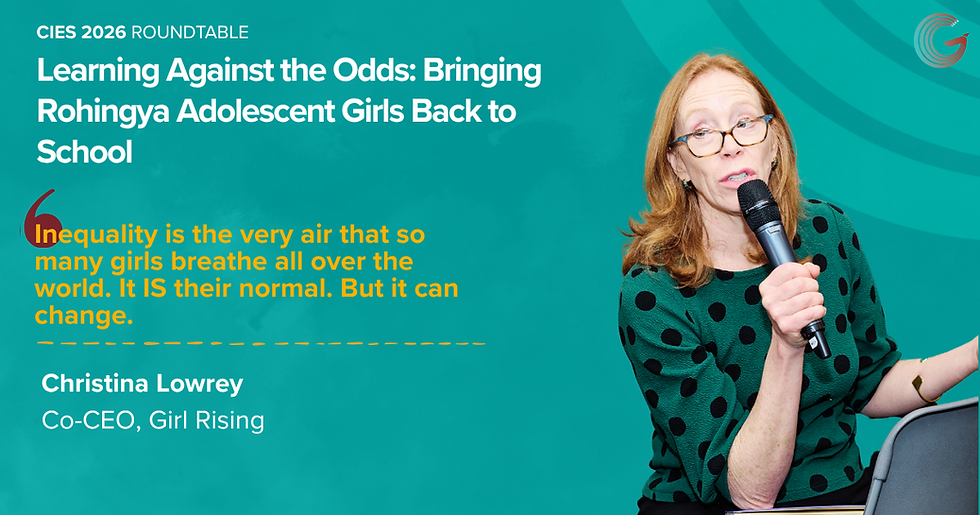
In Cox's Bazar, Bangladesh — home to one of the world's largest refugee camps — adolescent girls are disappearing from education. Not all at once, but gradually, systematically, as they grow older and the weight of gender norms, early marriage, and household responsibilities makes staying in school feel less and less possible.
The numbers tell a sobering story. A 2024 UNICEF survey of over 21,975 out-of-school girls aged 11–18 in the Cox's Bazar camps found that while 75% of girls aged 5–14 were enrolled in an educational programme, that figure collapsed to just 8% for girls aged 15–18. Nearly half of 18-year-old girls were not attending any form of learning facility. Among the reasons girls gave: feeling too old to study, household responsibilities and pressure to marry early, the absence of female teachers, and lack of parental support.
This is the reality that Girl Rising's RISE programme in Cox's Bazar is designed to address — and the evidence we are sharing this week at CIES 2026.
A Targeted Response, Built from the Ground Up
In collaboration with UNICEF and evaluation partner GAGE (Gender and Adolescence: Global Evidence), Girl Rising designed a targeted pilot for 500 at-risk adolescent girls aged 11 and above, alongside 500 parents, across 53 learning centres in six camps.
The starting point was listening. A needs assessment revealed low literacy levels among both adolescents and parents, a widespread perception that education held little value, and Gender Officers with limited exposure to social-emotional learning. The curriculum was adapted accordingly — incorporating play-based activities and local role models to make content accessible to low-literacy groups, and refining it through validation sessions with Gender Officers on the ground.
The result was a 12-session curriculum for adolescents focused on social-emotional learning, emotional resilience, critical reflection on gender norms, and leadership — paired with a 6-session curriculum for parents to build emotional intelligence and practical strategies for supporting their daughters' aspirations. A four-day Training of Trainers workshop equipped 36 facilitators to deliver the programme, with implementation strategies co-created with facilitators and a WhatsApp group used for real-time coordination throughout.
What Changed
Before training even began, just 34% of facilitators reported having an understanding of social-emotional learning. After the four-day workshop, that figure rose to 87%. Confidence in shaping girls' self-belief increased from 58% to 87%; confidence in helping girls think differently about gender norms moved from 56% to 82%.
Among the 522 adolescent girls surveyed across six camps, girls reporting comfort expressing their opinions to elders rose from 56% to 69%. Girls who discussed their dreams with their fathers increased from 47% to 78%. And girls aspiring to attain at least some university education more than doubled — from 9% to 24%.
Among caregivers, the share disagreeing that only boys should attend secondary school if a family can afford schooling for one child rose from 40% to 52%. Those disagreeing that girls should attend school only if not needed at home increased from 61% to 74%. The expected age for a girl to leave full-time education shifted from 18.2 to 18.9 years; the expected age of marriage moved from 19.9 to 20.6 years.
The qualitative data brings these numbers to life. A 15-year-old girl described how before the programme she and her classmates stayed quiet when teachers asked questions — but now they stand up with courage and confidence to answer. A 12-year-old reflected that she had learned how to nurture dreams inside herself, how to dream, and how to keep determination to achieve those dreams.
Fathers, too, were moved. One described his daughters as now so proactive and inquisitive that their mentor came to tell him they were asking some of the best questions in the room. Another said simply: if boys learn to support their sisters young, the community will change.
What Comes Next
GAGE will conduct a follow-up round of data collection in June 2026 to assess whether the programme's short-term effects have been sustained. Girl Rising recommends building on this pilot with a longer project for adolescent girls, and expanding programming to include boys as champions of gender equality — a recommendation echoed by the fathers themselves.
In fragile settings where rigid gender norms are most pronounced and the barriers to girls' education most acute, this pilot demonstrates that targeted, story-based, community-engaged programming can shift mindsets — among girls, among parents, and among the facilitators who reach them.


Comments