
Inside a RISE Classroom in Chhattisgarh: 2,331 Students and What Changed
Updated: May 6

By Richa Hingorani
The room was full. Senior government officials, teachers, principals, village leaders, and students all sat together, listening. When 15-year-old Reshma stood up, there was a brief hush. She looked small in that space, but the moment she began to speak, her presence felt much bigger.
She shared her own story.
As a participant in the RISE sessions at her school, Reshma spoke about what she had been learning. She began with something simple but deeply important: emotions. She shared how her teacher helped her understand that everyone feels many different emotions, and that this is completely normal. Feelings come and go like waves, she said, and every single one of them is valid. Then she spoke about another lesson that stayed with her: managing money wisely.
She shared a moment from her own life. Her parents had been planning to buy jewellery for her. It was a loving gesture, something many families do. But this time, Reshma paused and thought about what she had learned. She sat with her parents and talked about their budget. She said something that surprised even them: "Jewellery is not essential right now. My education is far more important." So instead of jewellery, she chose books.
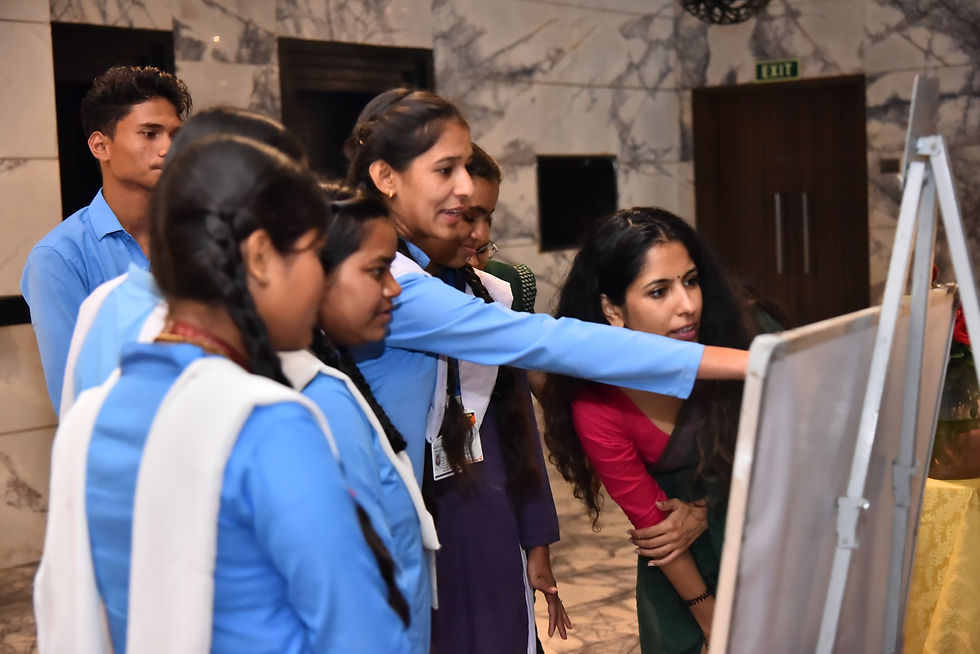
Before RISE arrived in Bilaspur, the numbers told a quiet story.
Only 14% of teachers in the programme's schools strongly believed that girls are as intelligent as boys. Only 38% of students had the emotional regulation skills to manage stress or difficult moments. One in five young people didn't believe they would continue their education beyond secondary school.
These weren't dramatic failures. They were the ordinary, invisible accumulation of what happens when systems don't prioritise young people and when classrooms reflect the world's limitations rather than its possibilities.
That's the world RISE walked into in April 2025.
Between April 2025 and January 2026, Girl Rising and Samarpit implemented the RISE curriculum (Resilient, Inclusive, Skilled, Educated) across seven government schools and four villages in Bilaspur, Chhattisgarh, with the support of the District Education Office. 2,331 students in grades 9 to 12. 35 teachers trained. 634 parents reached. Predominantly from tribal backgrounds. Predominantly first-generation learners.
What makes this work different is not just what happens in the classroom, but who is part of it. Students, teachers, and families are all engaged because change that only touches one layer doesn't last.
The evaluation data from the end of the programme offers a starting point for understanding what shifted.
By endline, 91% of teachers strongly believed girls could lead, up from 63%. Students' confidence in using the internet for learning rose from 85% to 98%. Financial literacy reached 94% of students at the endline. Among adolescent girls, commitment to continuing their education beyond secondary school rose from 84% to 93%.
These aren't abstract percentages. They represent specific young people in specific classrooms in Bilaspur, making decisions about their futures that they might not have made before.
The storytelling approach was central to how RISE opened these conversations. Stories, including the Kusum comic book and the Ruksana film, gave students a way into topics that might otherwise have felt too personal or too loaded to discuss directly. They created, as one teacher put it, a safe space.
On 17 April 2026, Bilaspur held its first-ever RISE celebration event.
As I watched the celebration unfold, with district leaders in attendance and teachers receiving laptops to continue building their digital skills in their classrooms, I felt both pride and responsibility. Pride in what this community has made possible together. And responsibility to ensure this work reaches further.
The Member of the Legislative Assembly,, the Mayor, and officials from the Ministry of Women and Child Development were all in attendance. For a programme that has spent a year working inside government schools with the support of district authorities, this wasn't just symbolic. It was a signal that the people with the power to scale this work were in the room, had heard what it produced, and were paying attention.

HP and the HP Foundation distributed laptops to students at the event, a concrete investment in the digital literacy that RISE had spent a year building. For students who had gone from 56% email confidence to 72%, the laptops weren't just hardware. They were the next chapter.

The results tell part of the story. More teachers now believe girls can lead. More students are confident using digital tools and making financial decisions. More girls are choosing to continue their education. But what stayed with me that day was not the data. It was the shift in the room. Teachers speaking about what they had seen change in their classrooms. Parents are showing up with a different sense of possibility for their daughters. Students speaking with clarity and confidence about their futures.
The evaluation report closes with a recommendation: expand RISE to other districts in Chhattisgarh, and beyond. Because what we saw in Bilaspur is not unique. It is what happens when young people are given the space, the skills, and the support to move forward.
In the end, it wasn't just Reshma's story that stayed with the room. It was what all their stories represented. Young people learning to think for themselves, to question, and to choose what truly matters.
And if this is what becomes possible when they are given the right space and support, then this is only the beginning.
RISE in Chhattisgarh was implemented by Girl Rising and Samarpit, Centre for Poverty Eradication and Social Research, Bilaspur, with support from the District Education Office, Bilaspur. Laptops were distributed in partnership with HP and the HP Foundation.


Comments