top of page

“What Would You Do?” - The game sparking conversations amongst adolescents from Kenya to classrooms worldwide

  • 4 hours ago
  • 5 min read

“A girl in your class stands up to answer a question and you see blood on the back of her dress…what would you do?” Esther, a leader at Haven of Dreams, a grassroots organisation in Nakuru, Kenya, posed the question to a circle of girls ages 12 - 14.


At first, the room was quiet. The girls looked down at the cards in their hands - the “answers” and started laying out possible responses.


“Make jokes about it.”


“Avoid interacting with others unless necessary.”


“Ask your teacher for extra work as a way to study.”


“Ask your friend if everything is okay.”


Giggles erupted.


The girls knew that making jokes was wrong. They knew that asking for extra homework made no sense. And while “Is everything okay?” missed the point - after all, menstruation is normal - they recognised the instinct behind it: talk to your friend, be kind, don't leave her alone.


The girls were used to carrying difficult questions quietly…about relationships, pressure, teenage pregnancy, early marriage, and violence. Conversations about these hard topics rarely happened at home or in classrooms. Even in safe spaces, many girls stayed quiet - afraid of breaking taboos or saying something embarrassing.


But something shifted when Esther introduced What Would You Do? A card game designed for girls to safely explore sexual and reproductive health and rights, healthy relationships, peer pressure, and personal boundaries through conversation, play, and mentorship.


The game was created in response to a challenge that community-based organisations across Africa, Asia, and Latin America kept raising. Mentors knew girls needed honest conversations about relationships, consent, bodily autonomy, and reproductive health. But many felt unequipped to start those conversations themselves. These topics were often considered taboo within families and communities, and both girls and adults arrived carrying fear, discomfort, and silence.


So instead of creating another training manual or workshop, we turned it into something children know best: play.


The idea was simple. If girls could explore difficult situations through a game, the heaviness would disappear. Conversations that felt impossible would become easier. Girls could talk about their bodies, relationships, and rights in ways that felt safe rather than intimidating.


The game itself was built with girls from the beginning. One of the earliest contributors was Esther, then a 19-year-old volunteer who helped shape and test the first questions with girls.


Alongside members of the Girls Advisory Council from different countries, she helped ensure the scenarios reflected the realities girls were actually navigating.


The result was a deck filled with situations that girls recognised immediately:


Your boyfriend says that if you really love him, you'll have sex with him.


You see a teacher touching a student in a way that makes you uncomfortable.


Someone keeps asking questions about your body that make you uneasy.


Your friend is being pressured into marriage during the school holidays.


Because the situations came directly from girls' lived experiences, girls who played the game often shared a powerful response: "I feel seen."


Many realised for the first time that the challenges they faced were not unique to them. Other girls were experiencing similar pressures, fears, and questions.


Importantly, the game is never played without a mentor. While girls often instinctively know what feels right or wrong, they need trusted adults who can help guide conversations, challenge harmful ideas, and create spaces where girls feel believed. For many girls, one of the greatest fears is that adults won't trust their experiences. The mentor's role is to ensure girls are heard, supported, and never left to navigate difficult situations alone.


Available in English and Spanish, and currently being translated into Kiswahili and Hindi, the game uses relatable real-life scenarios to make difficult conversations feel easier, safer, and more natural.


Since launching in 2022, the game has reached over 69,350 girls through 156 community organisations across Africa, Latin America, and South Asia. The What Would You Do? game has grown to be a valued resource for our network of community-based organisations in the Girls First Institute, and we are just beginning to integrate the game across our RISE programme in India. Here’s a glimpse of girls across the world already playing, laughing, debating, and finding their voices together.


Girls at Msichana Empowerment Kuria in Kenya gather, playing an intense game of What Would You Do? (Photo by Sarah Waiswa / @lafrohemien)
“Okay, here’s how you play…” demonstrates Florence Sidi as girls in Kenya dive into the What Would You Do? Game (Photo by Sarah Waiswa / @lafrohemien)
Designed for girls across three age groups, What Would You Do? uses play, peer conversation, and mentorship to help girls explore healthy relationships, consent, peer pressure, and personal boundaries in a safe and engaging way. Here we have curious girls in Tanzania during a mentorship session. (Photo by Pascal Arrey / Instagram: @arrey_shot_it)

Kate Kiama watches on as girls from partner GLAMI immerse themselves in lively discussion during a session of the game….debating, reflecting, and fully absorbed in the conversation. (Photo by Pascal Arrey / Instagram: @arrey_shot_it)
Girls in Moshi proudly pose with the What Would You Do? game after an afternoon filled with laughter, debate, and powerful conversations. (Photo by Pascal Arrey / Instagram: @arrey_shot_it)
At the Girls First Summit, one card game sparked some of the most powerful conversations in the room. The session took place during the seventh annual in Nairobi, where girls’ rights leaders and community organisations from across Africa came together to learn, connect, and reimagine how they support and advocate for girls. (Photo by Kate Lord)

Savana Kitui is a community-based organisation in Kenya and a member of She’s the First’s Partner Coalition uses the game to help girls explore healthy relationships, consent, and personal boundaries through play, discussion, and mentorship (Photo by Kate Lord)
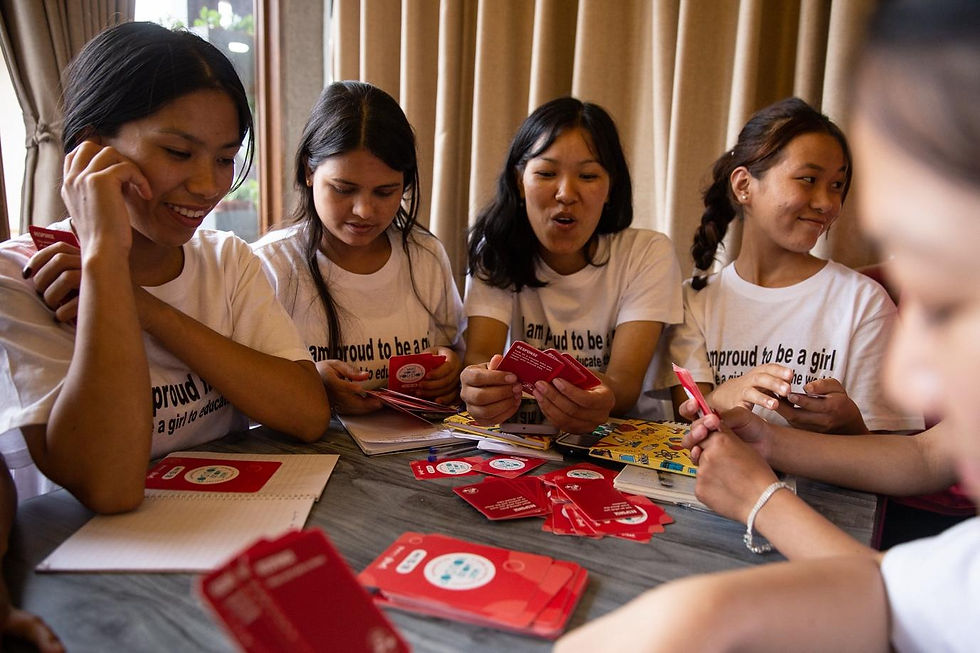
As the cards sparked questions, laughter, and debate, the girls began opening up about relationships, boundaries, and real-life challenges in ways that felt safe, honest, and fun. The Small World is a member the She’s the First Partner Coalition in Kathmandu, Nepal. (Photo by @Uma.Bista)
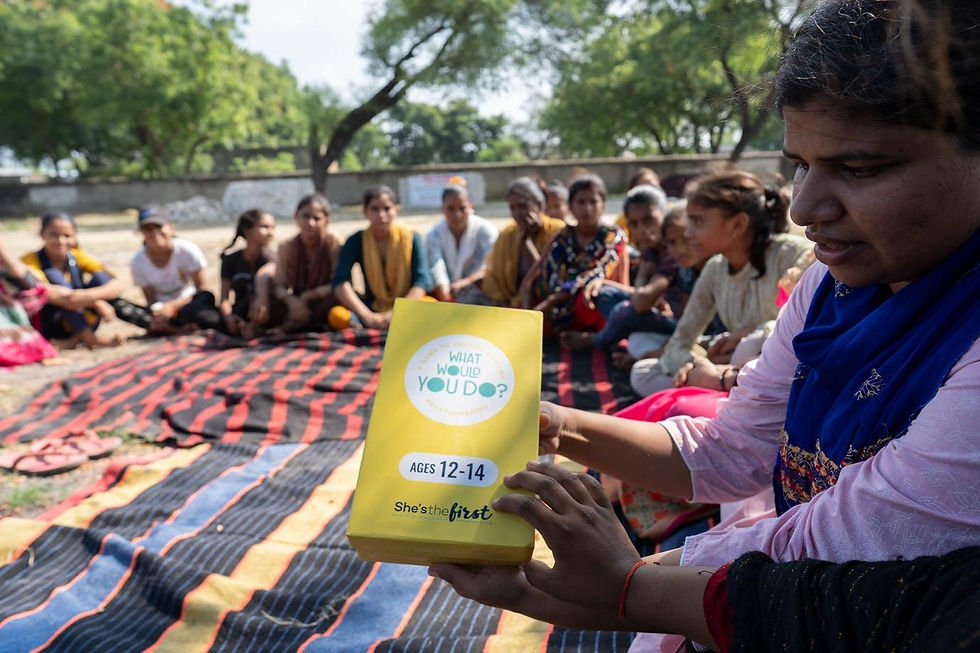
Mentor Mona Yadav leads a lively session of What Would You Do? with the “Sahasi Girls” in Khushipura village, Uttar Pradesh. Using relatable real-life scenarios, the game sparks honest conversations around relationships, confidence, boundaries, and decision-making among girls aged 9 to 18. (Photo by @RuhaniKaur)
The game comes alive through real-life situations faced by girls like 14-year-old Preeti, 15-year-old Ruby, and 17-year-old Kumar (left to right) near their local government school in Aligarh.(Photo by @RuhaniKaur)
Students in Dhading, Nepal play What Would You Do? during a mentorship session, opening up conversations around realities they live with every day but rarely get the chance to discuss.(Photo by @Uma.Bista)
Girls play What Would You Do? during the first-ever Ellas al Frente Summit in Panajachel, Guatemala, where girls and grassroots leaders from Guatemala, El Salvador, and Honduras came together to reimagine girl-centered leadership, mentorship, and safe spaces for girls.(Photo by @kinchofilms)


For those of you wanting to play this game with girls in your schools and neighbourhoods, fill out this form, and we’d be happy to send it across! 


Comments


bottom of page