
Feminine Moon, Fierce Truth
Gentle Visitations of the Feminine Moon
By Zuri Gabrielle Neghest, Girls Advisory Council member, 2026
Did you know that women and girls have an average of 450 menstrual cycles in their lifetime? That is quite a few chocolate cravings and cozy blankets! Since time immemorial, women and girls have had to navigate the monthly rhythms of their bodies. Menstruation, commonly known as a period, is a monthly shedding of the uterine lining when an egg isn’t fertilised. Periods are useful to us in two principal ways: First it is a sign of reproductive health, and second, it indicates the female body’s ability to potentially conceive.
Historically, menstruation has been a pivot of fascination and fear. The first recorded reference of menstruation is from the Ancient Egyptian medical tex, Ebers Papyrus dating back to 1550 BCE. The text consists of remedies and treatments for menstruation and menstrual issues such as irregular periods and menstrual cramps. Fascinating, right? Another ancient reference of menstruation is from Hippocrates, the Father of Medicine. He viewed menstruation as a natural process essential for a woman’s health. The Huangdi Neijing, a Chinese medical text, sees menstruation as a part of life energy flow. It discusses periods for overall health and balance in a woman’s body.
Sadly periods were not always as positively viewed in society. The philosopher Aristotle for instance, believed that menstruation blood was impure and a sign that women’s bodies were inferior. In medieval Japan, the Koryo rituals expose taboos around periods, like isolating women during their periods. During WWII, Nazi Germany’s propaganda used menstruation to justify restricting women’s roles, claiming that they were unfit for work and certain activities, tying it to their ideology of “racial hygiene”.
History reveals to us that societal views on menstrual purity and impurity vary in different parts of our world. Unfortunately, some of these beliefs haven’t changed much, and sadly menstruation is still viewed as shameful and socially verboten. While some women have been taught to embrace their bodies, other women are constantly suffering from the price of conservative traditions and taboos.
For instance, studies show that in parts of Ghana, menstrual taboos contribute to girls missing school during their periods, with 95% of girls in rural areas reporting absences. In some parts of India, women and girls are not allowed to enter temples, enter their kitchens, or touch food items. Such realities have brought us to this central question; How can we break these taboos once and for all?
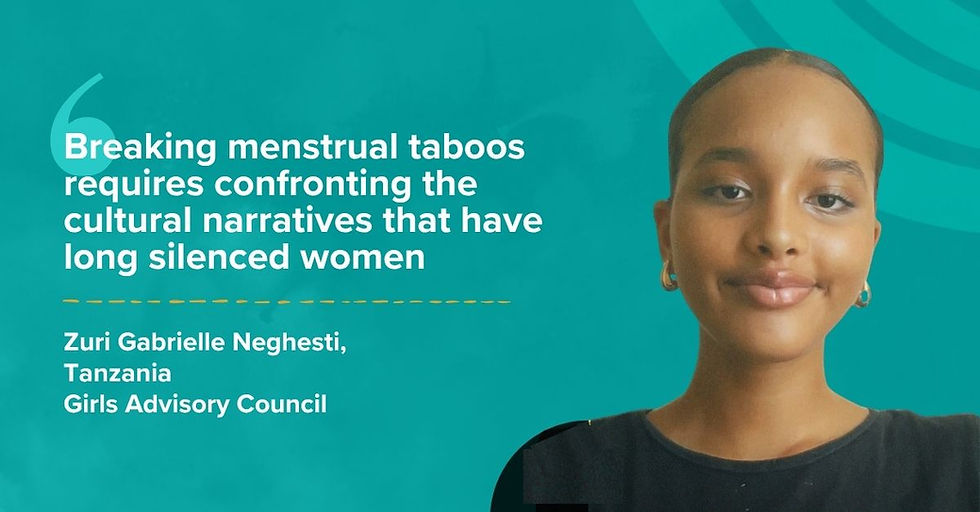
Breaking menstrual taboos requires confronting the cultural narratives that have long silenced women and girls'experiences, and contributed to serious consequences, including poor menstrual hygiene, increased risks of infections, and limited access to education and economic opportunities. The persistence of euphemisms like "That time of the month" or "feminine hygiene" reinforces the notion that menstruation is embarrassing. We need to talk about periods using straightforward language that can help dismantle these stigmas.
As writer Eve Ensler notes, "The period is a revolutionary act of defiance". This is a reminder that a woman’s body is capable of creation and power. Through promoting body literacy and self-acceptance, movements like Period Positivity have encouraged women and girls to view periods as a natural aspect of life. "You are not dirty, you're not unclean. Your body is doing things that it can't control and you need to see someone who knows what they're doing." Said Dr. Lauren Streicher, a professor of Obstetrics & Gynecology at Northwestern Medicine and a member of the Period Positivity Movement, who underscores the importance of normalizing menstruation and seeking guidance when lost.
Menstruation is more than an aspect. It is something beautiful. A gentle monthly visitation. It is a fierce truth that defines us as girls and women. We must celebrate our bodies for what they can do. It is something that will forever be a part of our lives, it is time we positively embrace it. Together, we can create a future where periods are met with acceptance and understanding!
That said, I wish you a Happy Menstruation Day!


Comments